Jul 23, 2026
EmpCo and nature-based claims: Why generic ESG advice falls short for forest and biodiversity communications
Generic ESG checklists weren't built for forestry or biodiversity claims. See what EmpCo changes for nature-based claims, with before/after rewrites.

Since the EU's Empowering Consumers Directive (EmpCo) was adopted, a wave of compliance checklists has appeared online. Most of them were written with fast fashion or packaged goods in mind: swap "eco-friendly" for something specific, stop using vague recyclability claims, cite a certification.
That advice is not wrong. It is just not written for you.
If your sustainability strategy is built around forest restoration, biodiversity conservation or nature-based carbon capture, your claims carry a different kind of risk. They are harder to falsify quickly, which makes them easy to overstate without anyone noticing for years, and much harder to defend once someone finally checks.
What EmpCo actually says
EmpCo, formally Directive (EU) 2024/825, was adopted in February 2024 and updates two existing pieces of EU consumer law: the Unfair Commercial Practices Directive and the Consumer Rights Directive. Its national rules apply from 27 September 2026 across all EU member states.
In practical terms, it restricts two things: making a general environmental claim (such as "eco-friendly" or "green") without clear, verifiable evidence to back it up, and using a sustainability label unless it comes from an approved certification scheme or a public authority. The aim is to stop vague or future-facing claims from standing in for evidence that has actually been verified.
For businesses funding forest, biodiversity or carbon programmes, this matters because so much of the language used to describe that work, "protected," "restored," "carbon neutral", falls squarely into the category of general claims EmpCo is designed to catch.
Why nature-based claims break differently
Three features of nature-based communication make generic ESG advice a poor fit.
1. The time horizon problem
A recyclable packaging claim can be verified today. A biodiversity restoration outcome cannot; the forest you are funding this year will not show measurable results for a decade or more. Communicating in the present tense about outcomes that are, by design, still unfolding is one of the most common sources of unsubstantiated claims.
2. The ex-ante versus ex-post problem
Carbon credits tied to forestry are frequently sold and communicated before the sequestration they represent has actually occurred. Under EmpCo, the distinction between "this carbon will be captured" and "this carbon has been captured" is not a technicality. It changes whether the claim is a projection or a fact, and each requires different substantiation.
3. The guarantee problem
Ecosystems are not machines. A forestry programme can guarantee that certain practices are followed; it cannot guarantee that a given hectare will deliver a specific biodiversity outcome, because natural systems have variability that a factory process does not. Claims that borrow the certainty of an industrial process, "guaranteed carbon capture," "assured biodiversity gains", are precisely the kind of overreach EmpCo is designed to catch.
None of this means nature-based claims are inherently riskier than other ESG claims. It means they need to be rewritten with these three failure points in mind, not run through a checklist built for a different sector entirely.
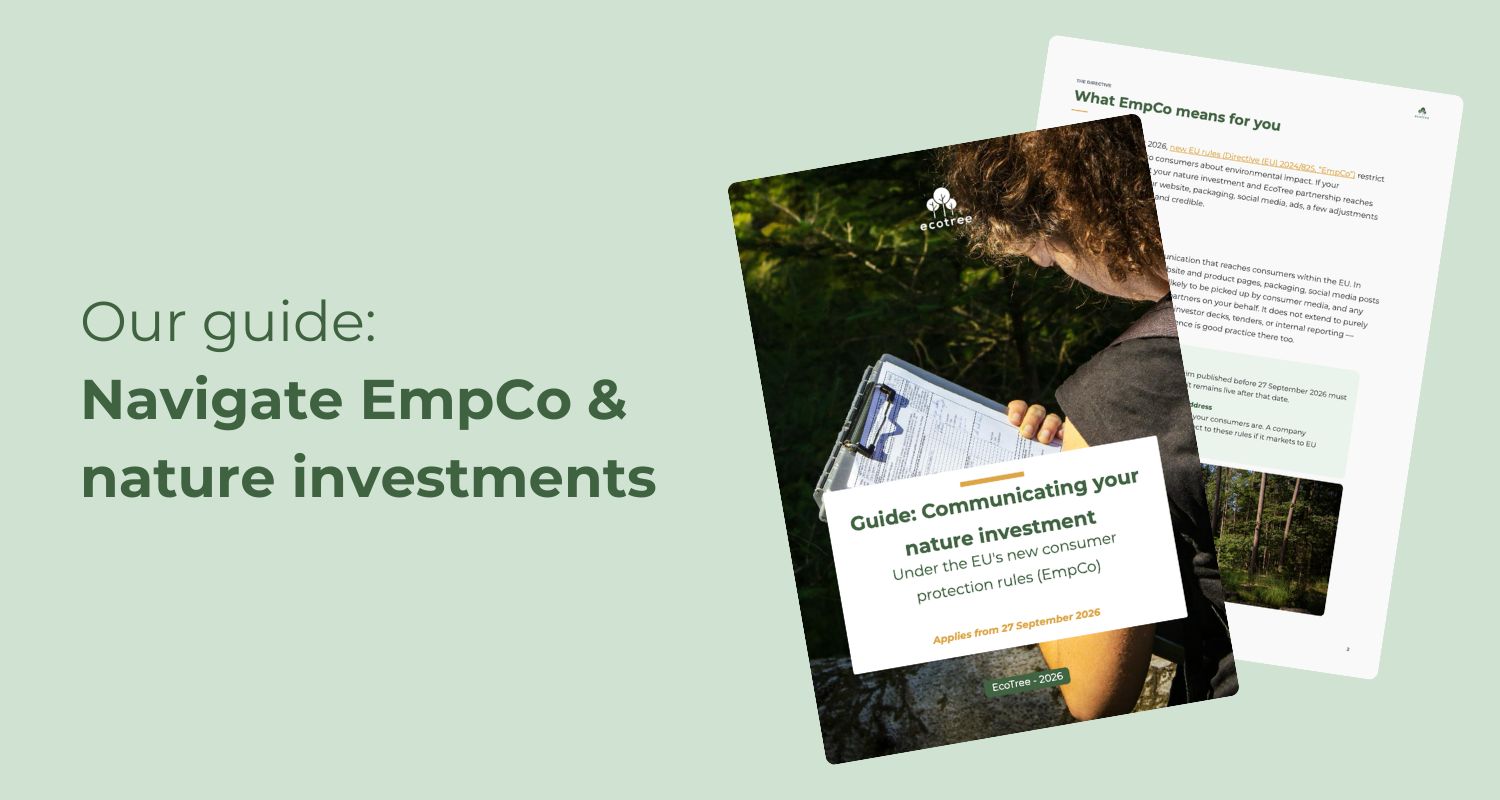
For a full sector-specific breakdown of what changes before 27 September 2026, EcoTree's EmpCo guide covers the practical detail; the sections below give you a starting point.
Rewriting the claims that won't survive scrutiny
Here is what the shift looks like in practice, using three phrasings that appear constantly in nature-based sustainability communication.
Example A: Carbon contribution
- Before: "We are carbon neutral thanks to our forest investment."
- Why it fails: it treats an ongoing, multi-year sequestration process as a completed, present-tense fact.
- After: "We are funding a certified forest-based carbon programme in [location*], projected to sequester [X] tonnes of CO₂ over [Y] years."
* Name the exact forest, city or department the project is located in. You could even mention the project developer for more transparency.
It's also important to note that carbon contributions are not offsetting and should never be considered as such. Carbon contributions should be financed alongside or as additions to an emission reduction and avoidance strategy. Read more about our carbon contribution option.
Example B: Tree planting
- Before: "We plant a tree for every purchase to protect biodiversity."
- Why it fails: it implies a direct, guaranteed biodiversity outcome from a single tree, which no forestry programme can promise.
- After: "For every purchase, we fund tree planting in a certified reforestation programme in [project name or location] designed to support long-term biodiversity restoration."
Example C: Support to afforestation or reforestation
- Before: "Our partnership supports thriving, protected forests."
- Why it fails: "protected" and "thriving" are unqualified descriptors with no evidence attached.
- After: "Our partnership funds forestry managed under [named certification], with independent monitoring of forest cover and biodiversity indicators."
The pattern across all three: move from outcome to mechanism, from guarantee to named evidence, and from present tense to the correct tense for what has actually happened versus what is projected.
A short checklist for nature-based claims
Before publishing any claim tied to forest, biodiversity or nature-based carbon work, check whether it:
- States an outcome as complete when it is still in progress,
- Implies a guarantee that natural variability makes impossible to promise,
- Relies on a general descriptor ("thriving," "protected," "restored") without a named certification or dataset behind it,
- Would still be accurate if read a decade from now, not just on the day it was published.
If a claim fails any of these, it is a candidate for rewriting, not necessarily for removal. Most nature-based sustainability work is genuinely well-evidenced; the gap is usually in how it is worded, not in what is being done.
Where to go deeper
The principles above apply across forestry, biodiversity and nature-based carbon programmes generally. Anchoring your specific claims correctly, and choosing the right level of detail for your market, depends on the certifications and data you already hold.
EcoTree's guide to communicating your nature investment under EmpCo sets out the five practical changes to make before the September deadline, along with guidance on which figures can be stated as fact and which should be framed as projections. It is free to download and built specifically for businesses working with afforestation, reforestation, biodiversity and carbon partnerships.