Jun 11, 2026
From SDGs to sustainability reports: How EcoTree's Nature-based Solutions contribute to five global goals
EcoTree's Nature-based Solutions contribute to five SDGs, with certified projects across Europe. See how that maps to your CSRD and ESRS E4 obligations.
The UN Sustainable Development Goals were never designed as a marketing framework. But for sustainability managers and CSR leads building their CSRD disclosures today, they have become something more practical: a common language for communicating environmental and social performance to regulators, investors, and stakeholders.
Under ESRS E4 (Biodiversity and Ecosystems) and the EU Green Taxonomy's environmental objective No. 4, companies are increasingly expected to show not just intent, but traceable action. Nature-based Solutions that align with recognised SDGs provide exactly that kind of documented, third-party-validated substance.
Here is how EcoTree’s project portfolio contributes to five of the 17 SDGs:
SDG 6: Clean water and sanitation
Why it matters for corporate reporting
Water risk is moving up the materiality agenda. For companies with water-intensive operations or supply chains in ecologically sensitive areas, demonstrating contribution to watershed health is increasingly relevant under CSRD and SFDR disclosures.
How EcoTree contributes
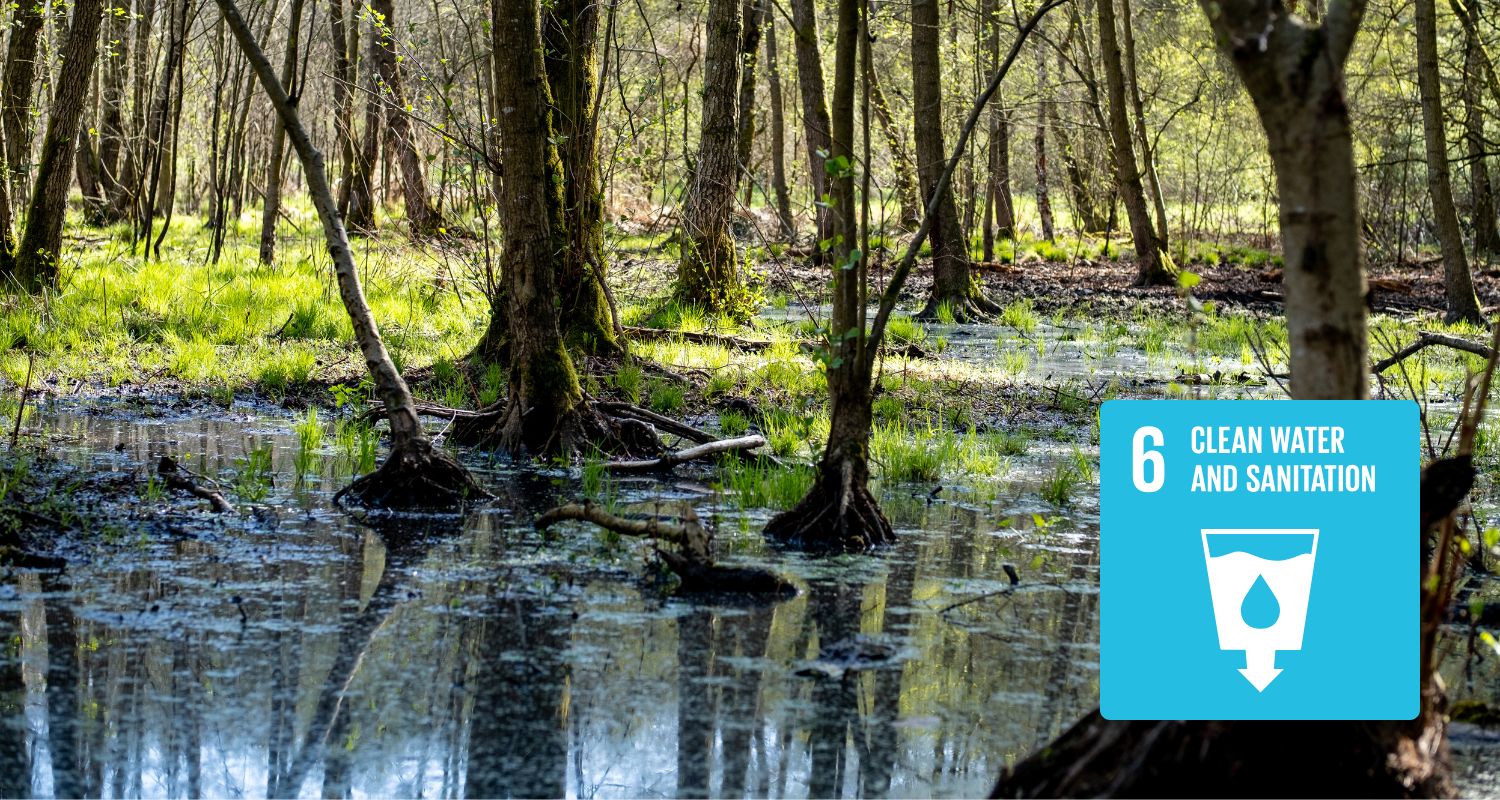
Wetlands and healthy forest ecosystems play a direct role in water filtration, flood regulation, and groundwater recharge. EcoTree currently manages wetland restoration projects across France, Germany and Denmark, alongside work in Belgian peatland ecosystems, contributing to hydrological function at a landscape scale. Across our portfolio, the biodiversity projects include more than 40 ponds created and/or maintained, and 150 hectares of wetland habitat under active management.
In practice
EcoTree is involved in the restoration of the Black Creek Valley, in Belgium, a peatland ecosystem of recognised ecological importance. Peatlands act as natural water stores and filters; the restoration work focuses on re-establishing the hydrological conditions that underpin these functions. Monitoring of ecosystem outcomes is ongoing. Companies that contribute to this project can use the project data in their ESRS E4 reporting.
Read more about which projects can be integrated into your ESRS E1, E3, and E4-reporting.
SDG 8: Decent work and economic growth
Why it matters for corporate reporting
The social dimension of sustainability strategies is under increasing scrutiny. CSRD's double materiality framework requires companies to consider not just environmental impact but social value creation, including contributions to employment and economic inclusion in the communities where they operate.
How EcoTree contributes
Our forest management operations generate direct, skilled employment in rural areas across Europe. Forestry work is inherently local and labour-intensive, creating demand for qualified workers in regions where rural employment opportunities are often limited. EcoTree actively applies social insertion clauses in its forestry procurement, meaning a portion of contracted labour is specifically drawn from people in structured reintegration programmes.
In practice
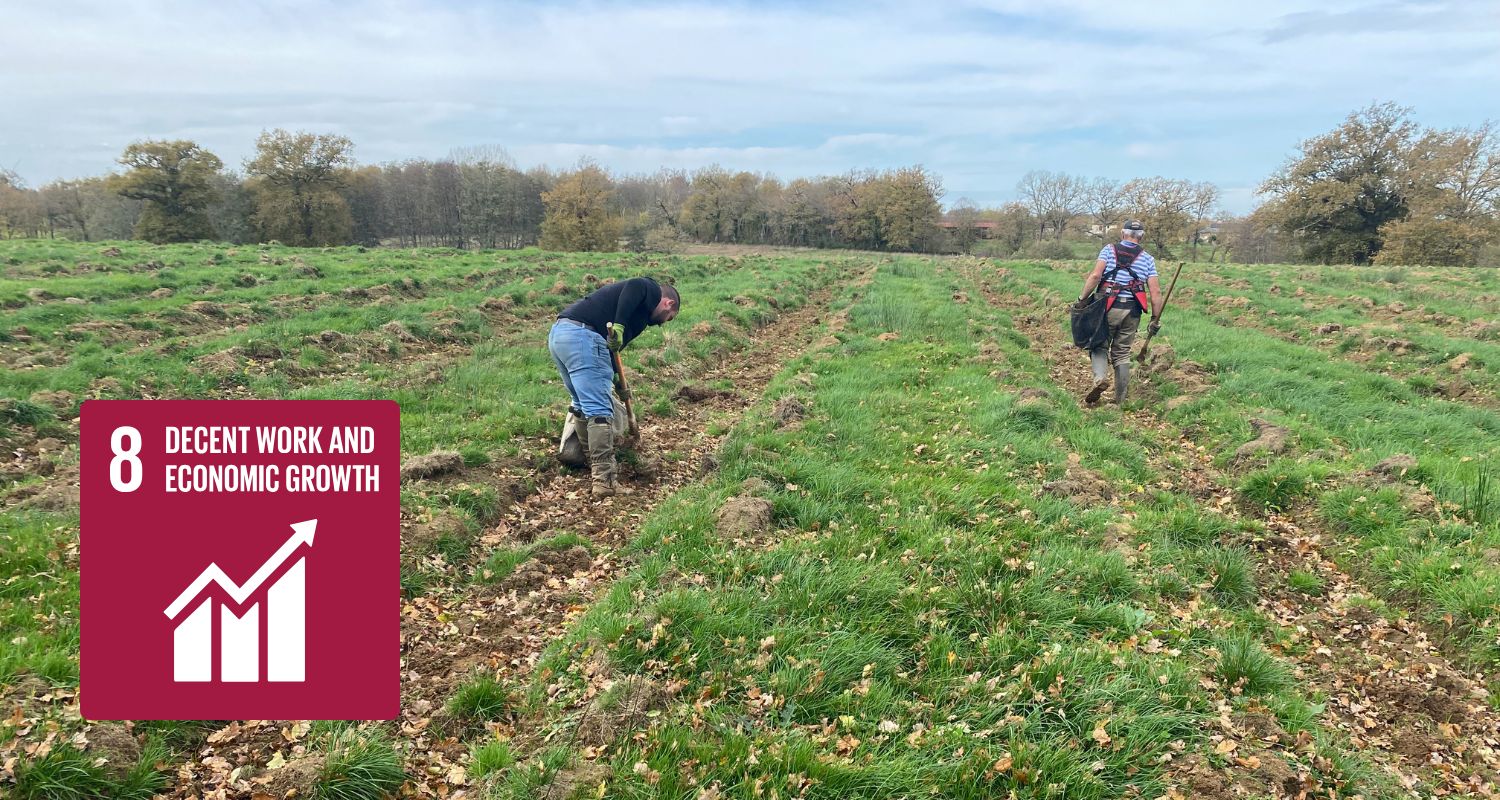
EcoTree's ongoing partnership with Start People, one of France's largest staffing groups, now spans five French forests. At the most recent project, the Peyrat-de-Bellac forest in Haute-Vienne, 10 temporary forestry workers were employed through Start People agencies, of whom 7 were engaged under formal social insertion clauses (clauses sociales d'insertion). The planting of 6,667 trees, including sessile oaks, wild cherries, and sycamore maples, also involved Association REMPART 87, a local organisation that supports people distant from the labour market. The partnership is ongoing, with EcoTree working directly with Start People agencies in Saint-Dié-des-Vosges and Sens.
This is not a peripheral ESG initiative. Social insertion clauses are a recognised procurement mechanism under French law, and their application in EcoTree's forestry operations provides a documented, verifiable link between forest management activity and SDG 8 outcomes.
SDG 12: Responsible consumption and production
Why it matters for corporate reporting
Companies under CSRD are expected to address their environmental footprint across the value chain. Investments in certified sustainable land management are a credible component of a responsible production strategy.
How EcoTree contributes
EcoTree's forests are managed under FSC and PEFC certification, with biodiversity monitoring embedded across the portfolio. The majority of EcoTree's forests carry an Index for Biodiversity Potential (IBP) assessment, providing a documented baseline against which management impact can be measured over time. Across the portfolio, biodiversity stewardship measures include 7 km of honey hedges and fruit trees, 7,000 m² of wild orchards, 15,000 m² of managed meadows and fallows, and 27 hectares of untouched forest areas left for natural regeneration.
In practice
The Monceaux-sur-Dordogne forest in France is a certified biodiversity project within EcoTree's portfolio, which is managed under documented protocols that balance long-term forest productivity with ecosystem integrity, providing companies with a traceable link between their Nature-based Solutions investment and responsible land-use standards.
SDG 13: Climate action
Why it matters for corporate reporting
Climate Action is the SDG most directly connected to net-zero commitments, Scope 3 reporting, and EU Taxonomy alignment. Forest ecosystems contribute to long-term carbon sequestration, though carbon storage, carbon credits, and carbon offsetting are distinct concepts that require separate treatment in corporate disclosures.
How EcoTree contributes
EcoTree's afforestation and reforestation projects contribute to carbon sequestration through the growth of managed forest ecosystems, verified under multiple internationally recognised methodologies. Under the Label Bas Carbone (LBC) methodology, 100,000 tonnes of CO₂ equivalent have been certified across 50 afforestation and reforestation projects in France, covering more than 300 hectares. A further 130,000 tonnes have been verified under Bureau Veritas methodology across 32 EcoTree-owned forestry projects. Additional projects operate under MoorFutures, EVA Wald-Klimastandard, the Peatland Carbon Code, and the Woodland Carbon Code.
These figures represent certified carbon storage and credit issuance under third-party methodologies. They are not interchangeable with Scope 1, 2, or 3 offset claims, and EcoTree's advisory team works with partner companies to ensure carbon contributions are reported accurately and within the appropriate regulatory framework.
In practice
One of EcoTree’s latest carbon projects includes the Priziac forest in Morbihan, a 49-hectare reforestation project where more than 35,000 trees will be planted, generating 8,877 carbon credits. The planting of 11 different tree species is scheduled for the winter season of 2026/27.
SDG 15: Life on land
Why it matters for corporate reporting
ESRS E4 is one of the most demanding new disclosure obligations under CSRD, requiring companies to assess and report on their dependencies and impacts on biodiversity and ecosystems. Contributions to terrestrial ecosystem restoration need to be specific, located, and verifiable.
How EcoTree contributes
EcoTree's portfolio includes more than 700 hectares within Natura 2000 zones or classified natural areas (ZNIEFF I and II), alongside 150 hectares of wetland habitat under active restoration. IBP assessments are in place across the majority of EcoTree's forests, providing a quantified baseline for biodiversity monitoring. Habitat infrastructure across the portfolio includes 111 bird boxes installed and 27 hectares of forest left entirely unmanaged to support natural ecological processes. EcoTree also contributes to ecosystem restoration by the square metre through its biodiversity offer, allowing companies to link investment directly to measurable land area restored.
In practice
A project contributing to SDG 15, which is also applicable for ESRS E4, is our ecosystem restoration project in Langoëlan in France. Here we are restoring just under 16 hectares of ecosystem, five hectares of wetland and creating 4 forest ponds for amphibians and ordonates. The project also sits within a Natura 2000 zone.
A multi-SDG approach to sustainability strategy
For companies building CSRD disclosures, the practical value of Nature-based Solutions lies not in ticking individual SDG boxes, but in demonstrating that environmental investments are coherent, managed, and independently verified. A single EcoTree forest project can contribute to climate action through certified carbon sequestration, to biodiversity conservation through IBP-monitored management, and to responsible land use through FSC or PEFC certification, all within one auditable investment.
Read about all 17 UN Sustainable Development Goals here.
EcoTree works with more than 3,000 partner companies across Europe at every stage of their Nature-based Solutions strategy, from initial project selection and contribution framing through to reporting support aligned with CSRD, ESRS E4, and the EU Green Taxonomy. Its advisory offer includes avoidance, reduction and contribution strategy, as well as training and consulting on carbon, biodiversity, and regulatory reporting frameworks.
If you are building or reviewing your sustainability or non-financial reporting and want to understand how EcoTree's projects can contribute to your SDG disclosures, speak to our advisory team.